Evidential crack — my own photographs
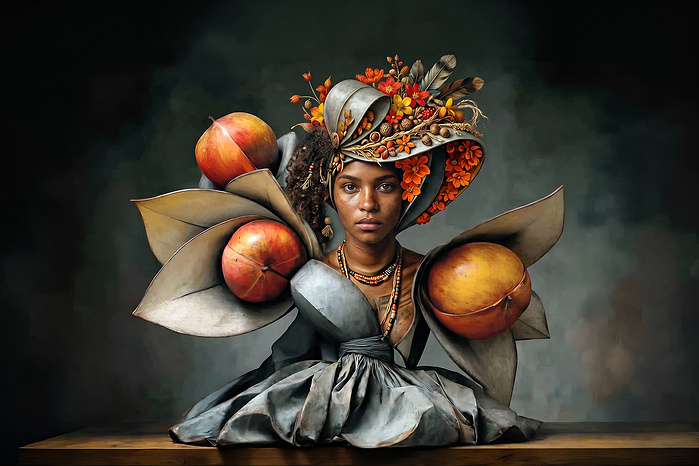
Each figure is posed like a portrait bust: in profile, composed, sovereign. And from the neck down each has become a still life — fruit, petals, leaves arranged into a torso, a gown, a pedestal. The body is no longer a body. It has been set out for the eye, balanced and made beautiful to look at, the way painting has arranged fruit and game for four centuries.
Only the face refuses. It stays intact, turned away, unwilling to be consumed with the eyes. Everything below has been reduced to composition; the face has not. That refusal is the whole of the work — and it has a name: dignity, held not as a virtue but as an act of resistance. It is the one thing that cannot be arranged, and the one thing no gaze can take.
This is why the title is read twice. Still life, the genre of the arranged and the inanimate — and still, life: alive in spite of it all. What survives the reduction to ornament is exactly that: a life that will not stop being a subject, however thoroughly the body has been turned into an object.
The series makes a quiet accusation, and its target is the viewer. To find these figures beautiful is to do to them exactly what the image describes — to reduce a person to something lovely to look at. The averted face answers back. It defends no culture and no cause; it defends something barer — the right not to be looked at as a beautiful thing. You may observe the body. You will not possess the person.


