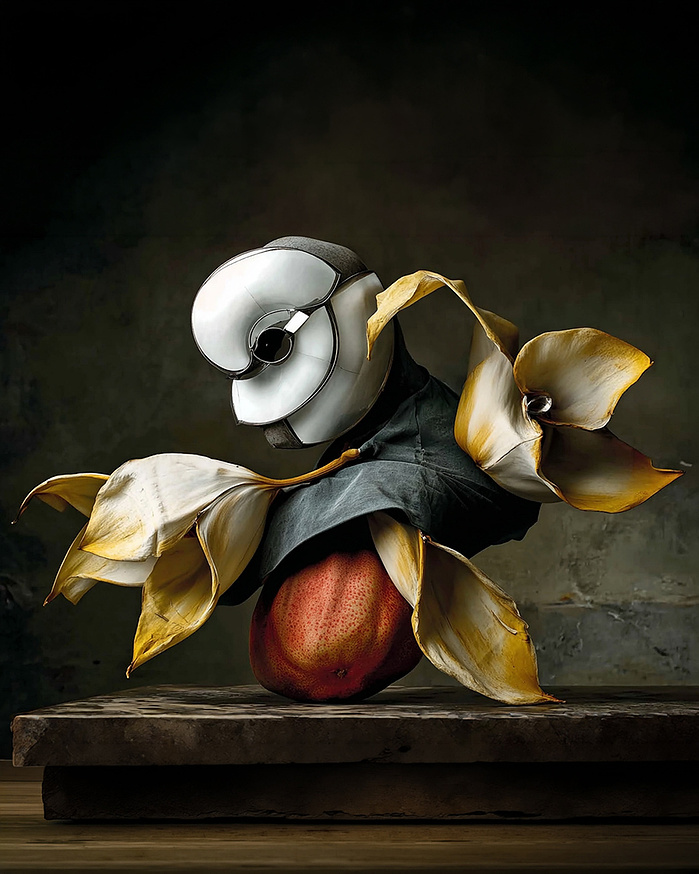
In Ikebana, beauty is never the property of a single stem — it emerges from the relationship between elements, none allowed to dominate.
Equilibrio applies the same law to the still life: fruit, flower, leaf, and human form gathered into a single composition where no element claims the center.
The human figure appears throughout this series, but never as protagonist. A face, masked and quiet, rests among the fruit and the foliage — present, but not privileged. This is deliberate: humanity does not stand outside nature, looking in. It is one relation among many, one weight on a scale that must stay balanced to hold any beauty at all.
What looks like a classical still life is, underneath, a quiet argument: remove the human from the center, and the world does not lose its order — it finds a truer one.


